Introduction
HILIC (Hydrophilic Interaction Liquid Chromatography) has become one of the most important chromatographic approaches for the analysis of polar compounds. Metabolites, amino acids, organic acids, pharmaceuticals, peptides, and other hydrophilic analytes often exhibit poor retention in traditional reversed phase chromatography, making HILIC an attractive alternative.
While many columns are classified as HILIC, not all HILIC columns operate through the same retention processes.
Cogent™ TYPE-C™ columns, including:
- Diamond Hydride™
- Phenyl Hydride™
- Amide™
- Silica-C™
are HILIC columns designed for polar compound separations and LC-MS applications. However, the underlying retention mechanism responsible for their HILIC performance differs from that commonly proposed for traditional hydrophilic HILIC stationary phases.
Understanding these differences helps explain why TYPE-C™ columns often provide exceptional retention, reproducibility, and method robustness for polar compounds.
Understanding HILIC Chromatography
In practical chromatography, HILIC generally refers to methods that:
- Retain polar compounds
- Use acetonitrile-rich mobile phases
- Employ low aqueous content
- Use inverse gradients where increasing water reduces retention
- Provide excellent LC-MS compatibility
From a user's perspective, if a column effectively retains polar analytes under these conditions, it functions as a HILIC column. This is exactly how TYPE-C™ columns are used and why they are categorized as HILIC columns.
Traditional HILIC Columns
Conventional HILIC stationary phases typically use highly hydrophilic surfaces such as:
- Bare silica
- Amide phases
- Zwitterionic phases
- Polyol phases
- Other polar bonded chemistries
The commonly accepted retention model for these materials involves a water-enriched layer that forms on the stationary phase surface.
In this model:
- Polar analytes partition into the water-rich region.
- Retention is influenced by hydration layer thickness.
- Equilibration depends on rebuilding this surface environment.
Because this layer is dynamic, retention can be influenced by:
- Buffer concentration
- Temperature
- Mobile phase history
- Equilibration time
- Instrument conditions
HILIC on TYPE-C™ Silica Hydride Columns
TYPE-C™ columns are fundamentally different because they are built upon a silica hydride surface rather than traditional hydrophilic silica. Research has shown that silica hydride phases do not maintain the extensive water layer commonly associated with conventional HILIC materials.
Instead, polar analyte retention occurs through a different mechanism involving:
- Surface interactions
- Solvent displacement effects
- Charge-related interactions
- Polar adsorption processes
Historically, this retention mechanism was referred to as:
Aqueous Normal Phase (ANP)
Today, these separations are appropriately described as HILIC because they are used for the same purpose:
- Retention of polar compounds
- High-organic mobile phases
- LC-MS compatibility
- HILIC method development
The distinction is simply that TYPE-C™ columns achieve HILIC performance through a different surface chemistry.
Why TYPE-C™ Columns Often Equilibrate Faster
One practical advantage frequently observed with TYPE-C™ columns is rapid equilibration.
Traditional HILIC columns often require substantial equilibration because their retention behavior depends heavily on restoration of the surface hydration environment.
TYPE-C™ silica hydride phases generally equilibrate much more quickly because:
- Large hydration shells do not need to be re-established.
- Retention is less dependent on water-layer rebuilding.
- Surface interactions stabilize rapidly.
Benefits include:
- Faster method startup
- Reduced solvent consumption
- Greater sample throughput
- Improved productivity
Advantages for LC-MS Applications
TYPE-C™ columns are particularly effective for LC-MS because HILIC methods typically use:
- High acetonitrile concentrations
- Volatile additives
- Low aqueous content
These conditions often improve:
- Desolvation efficiency
- Ionization efficiency
- MS sensitivity
In addition, many methods can be performed using relatively low concentrations of:
- Ammonium acetate
- Ammonium formate
- Formic acid
- Acetic acid
This can help reduce:
- Ion source contamination
- Maintenance requirements
- Instrument downtime
Retention and Selectivity Benefits
TYPE-C™ columns provide strong retention of many analyte classes including:
- Organic acids
- Amines
- Metabolites
- Peptides
- Pharmaceuticals
- Zwitterions
- Biomolecules
In addition to HILIC retention, some TYPE-C™ phases may exhibit additional selectivity through interactions not commonly observed on conventional HILIC columns.
This expanded selectivity often provides advantages during method development for difficult compounds.
Robustness and Reproducibility
One of the most commonly reported benefits of TYPE-C™ columns is retention reproducibility.
Users often observe:
- Stable retention times
- Consistent gradients
- Reliable method transfer
- Excellent sequence reproducibility
This consistency is particularly valuable in:
- LC-MS laboratories
- Pharmaceutical analysis
- Clinical research
- Metabolomics
- Quality control environments
Conceptual Illustration
HILIC Phases have a Water Shell Cogent TYPE-C Silica has no Water Shell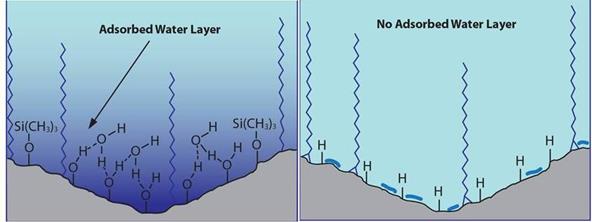
Practical Takeaways
- TYPE-C™ columns are HILIC columns designed for polar compound analysis.
- They operate using silica hydride surface chemistry rather than traditional hydrophilic silica chemistry.
- The historical term ANP describes the retention mechanism responsible for their HILIC performance.
- Faster equilibration is commonly observed compared with many traditional HILIC phases.
- Excellent LC-MS compatibility supports modern analytical workflows.
- Strong retention and unique selectivity make TYPE-C™ columns valuable for challenging polar analytes.
- Reproducibility and robustness are key advantages in routine analytical applications.
Key Takeaways
- HILIC describes a chromatographic approach for retaining polar compounds.
- TYPE-C™ columns fully operate as HILIC columns for analytical and LC-MS applications.
- The silica hydride surface provides a unique retention mechanism historically known as ANP.
- This mechanism helps explain rapid equilibration, reproducible retention, and strong polar analyte performance.
- Diamond Hydride™, Phenyl Hydride™, Amide™, and Silica-C™ all provide HILIC capabilities through the TYPE-C™ platform.
- Understanding the underlying mechanism helps explain why many laboratories experience improved HILIC performance with TYPE-C™ columns.
Additional Resources
For TYPE-C™ column specifications, HILIC method development guidance, LC-MS applications, product images, and ordering information, view: Cogent™ Diamond Hydride™, Phenyl Hydride™, Amide™, and Silica-C™ Column Specifications, HILIC Applications, LC-MS Methods, Product Images, and Ordering Information
A very popular journal article on this subject:
Journal of Chromatography A, E. Barto, A. Felinger & P. Jandera Investigation of the temperature dependence of water adsorption on silica-based stationary phases in hydrophilic interaction liquid chromatography, 2017, Volume
1489 pages 143-149